
How Much Net Buying Power Will ETH Lose When Bitmine Stops Buying?

 Prefer us on Google


Author: Azuma, Odaily Star Daily
Bitmine is just one step away from achieving its goal of holding 5% of ETH.
On November 10, digital asset reserve company Bitmine (NYSE: BMNR) disclosed its latest holding report. In the past week, the company increased its holdings by 9,587 ETH, bringing its total holdings to 6,070,092 ETH, valued at approximately $13.6 billion, accounting for 4.97% of Ethereum's current total supply. According to official statements, this ratio has reached 99% of its strategic goal of "holding 5% of the total supply of ETH."
The 5% holding target is a long-term plan proposed by Bitmine when it launched its ETH treasury strategy on June 30, 2025. Bitmine officially refers to it as "The Alchemy of 5%"—the reason for setting this number is that in the traditional U.S. stock market, 5% is the threshold that triggers SEC 13D mandatory disclosure, representing that a single shareholder begins to have substantial voting power.
At the Token2049 conference in October this year, Bitmine Chairman Tom Lee reiterated that 5% will become the hard cap for Bitmine's ETH holdings, and the company will not continue to increase its holdings beyond this ratio. In other words, once the final 1% purchase is completed, Bitmine's year-long ETH buying action will be put on hold.
Net Buying Power Will Inevitably Decline, No One Can Replace Bitmine
As Bitmine approaches its holding limit, the market is constantly looking for potential "successors"—for example, hoping that second-tier Ethereum treasuries (DATs) like SharpLink (holding about 870,000 ETH) and The Ether Machine (holding about 496,000 ETH) will expand their balance sheets, or expecting significant inflows from spot ETFs.
However, objectively speaking, it is unrealistic to rely on these forces to "replace" Bitmine for a simple reason: second-tier DATs and spot ETFs are not incremental narratives; they already exist on the table at this moment.
In the past year, every price battle of ETH has already accounted for the combined efforts of Bitmine, second-tier DAT treasuries, and ETF funds. Moreover, ETF funds have a strong pro-cyclical nature (buying high when prices rise and redeeming when prices fall), while second-tier treasuries are limited by their own market capitalization and mNAV discounts, making it difficult to replicate Bitmine's early ability to ignore bull and bear markets and consistently buy on a weekly basis.
Therefore, we do not need to seek psychological comfort by finding "other forces to step in" for ETH. Once Bitmine reaches the 5% cap and stops increasing its holdings, it objectively means that there will be one less source of continuous, rigid net buying power in the market.
The core question worth discussing is: how significant will the disappearance of this net buying power be for ETH?
6 Million ETH Is Huge, But the "Violent Buying Period" Has Long Passed
If we only look at the total amount, 6.07 million ETH, with a holding scale of up to $13.6 billion, will undoubtedly have a huge impact on ETH. As the second-largest crypto asset treasury in the world, only behind Strategy (formerly MicroStrategy), Bitmine alone has absorbed nearly 5% of the entire network's chips, and has locked over 80% of its ETH in staking nodes. The exit of such a buyer from the secondary market indeed sounds like a "bloodletting bearish signal."
However, if we look back at Bitmine's actual accumulation curve over the past 16 months, we will find a fact that is more in line with the current situation—Bitmine's "violent accumulation period" has long passed, and the closer it gets to the 5% target, the slower its accumulation speed becomes.
Combining treasury tracking data from The Block and Bitmine's previous holding disclosures, we can visually see the changes in Bitmine's buying slope each quarter.
The data clearly shows that Bitmine's real "violent accumulation" was almost entirely concentrated in the second half of 2025—at that time, it consumed over 4.1 million ETH at an astonishing rate of 100,000 to 200,000 ETH per week within six months.
However, entering the second half of 2026, especially since the third quarter, as its holdings approach the 5% target and BMNR's own stock price enters a discount zone, its pace of accumulation has significantly slowed. In the past two months, Bitmine's weekly net increase in ETH has only remained in the range of 8,000 to 15,000 ETH, equivalent to only $20 million to $30 million per week.
For a market like ETH, where the average daily trading volume easily exceeds hundreds of billions of dollars and spot ETFs can easily surpass $100 million in net inflows/outflows in a single day, a buying power of $20 million per week has had very limited actual impact on ETH prices in recent months.
No Need to Panic, the Market Has Already Adapted to Life Without Bitmine
In summary, Bitmine is about to complete the final progress bar of "The Alchemy of 5%", which indeed means that ETH has lost a symbolic off-market net buyer on paper, but the market need not fall into a panic of "buying power interruption"—because the most intense incremental buying power has already receded six months ago, and the secondary market has actually adapted and digested life without Bitmine's net buying power in the past few months.
When the final gap of about 35,000 ETH is filled, what disappears is only a weak marginal buying power of about 10,000 ETH per week; what remains for Ethereum is 6.07 million ETH that has been long locked in treasuries and staking nodes.
The narrative of Bitmine as a "buying engine" may soon turn the page, but this year-and-a-half-long chip locking experiment has already completed its historical mission.
-- Price
This content is provided for general informational purposes only and doesn't constitute financial, investment, legal, or tax advice. Any events, rewards, online promotions, or related information mentioned herein should not be considered a recommendation, solicitation, or invitation to purchase, sell, trade, or otherwise deal in any crypto assets. Crypto assets are highly volatile and may result in loss. The availability of WEEX services, products, and related events may vary by region. You are responsible for ensuring that your participation is in accordance with applicable local laws and regulations.
You may also like

LlamaRisk Proposes to Narrow Aave V3 Core Collateral Asset Range, Involving $1.33 Billion in Collateral

Algorithmic Trading and Cryptocurrencies: How Do Robots React to Volatility?

Cardano’s police evidence system could bring 1.5 million annual transactions

Confidence at Zero! Goldman Sachs Interprets Hedge Fund Positions: 'Surrender Liquidation', Largest Loss Since the Pandemic

47% Top Tax Rate Approaches: Seven Tax Reduction Strategies for Australian Crypto Investors
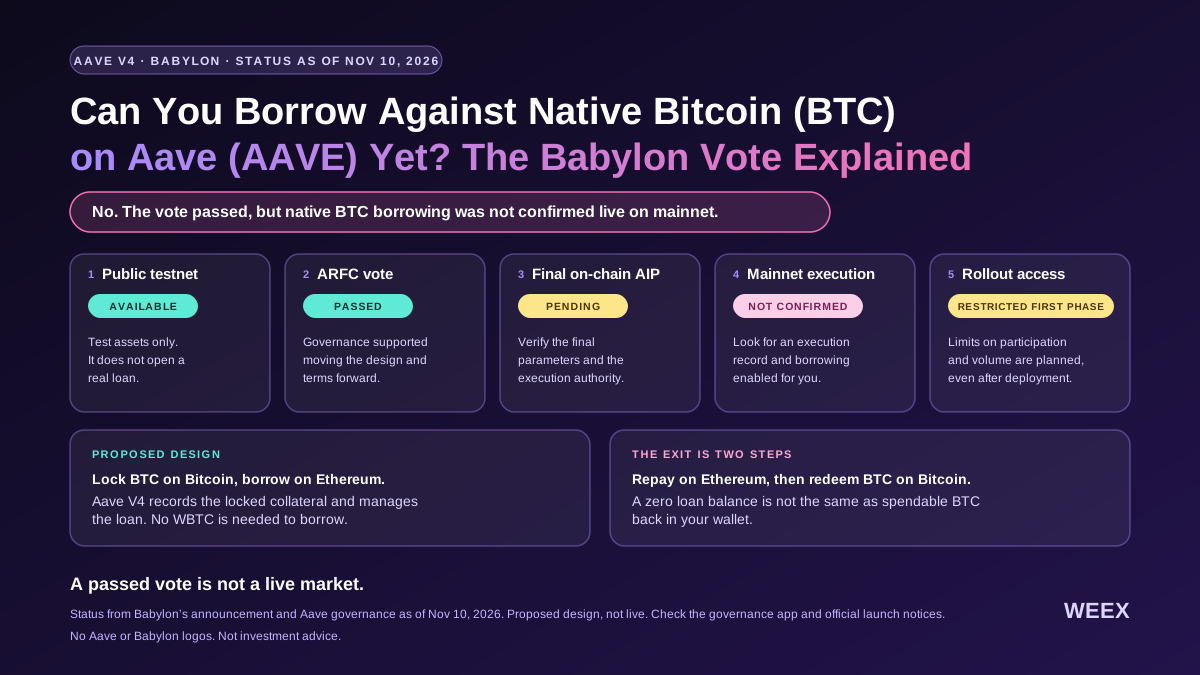
Can You Borrow Against Native Bitcoin (BTC) on Aave (AAVE) Yet? The Babylon Vote Explained
Can you borrow against native Bitcoin on Aave yet? See what the Babylon vote approved, what still needs to launch, and how BTC liquidation would work.

PIEVERSE Price Up Nearly 80% in a Week: Futures Activity, the November 14 Unlock and What Is Confirmed
PIEVERSE rose about 79% in seven days with futures volume far above spot. See what is confirmed about the November 14 unlock and the WEEX Lucky Eggs campaign.

Hong Kong Approves Crypto Asset Reporting Rules - Fintech World

NVDA Stock Falls 4.3% After Board Opens Investigation: What Is Confirmed and What Is Not
NVDA closed at $178.67 on November 9, 2026, down about 4.3%, after Nvidia’s board confirmed an independent investigation. Other claims come from media reports. WEEX’s Lucky Eggs campaign runs until November 25.

Chainalysis Report: Why Did Western Europe Withstand the Global Crypto Market Chill?

Four Security Strategies from the Wallet Theft Incident

Global Outage: Your Cryptos Are Not Disappearing

Did Strategy buy Bitcoin? Saylor reignites speculation

A New Chapter in the History of Rug Pulls in Crypto

From Binance Incubator to Nasdaq: Injective's Eight Years

tBTC Cross-Chain Bridge Resumes On-Chain Operations, Threshold Network Confirms Adequate Reserves

FinCEN Withdraws Proposed Crypto Travel Rule Expansion in Separate November Move

Finnish Startup Uses Heat from Bitcoin Miners to Heat 30 Homes

Analysis: The Logic of BTC's Periodic Recovery Remains Unshaken, Losses and Panic Have Been Fully Released
Undervalued Opportunities in the Crypto Market: Funding Rates Can Be Traded Separately

Centrifuge Launches Schroders Emerging Market Bond Fund Tokenization Product on Solana

FinCEN and the Federal Reserve Withdraw Proposal to Adjust Cross-Border Transfer Rules
US sanctions hit 41 companies accused of keeping Prince Group’s scam network running

Zcash’s new security fund is 99.7% old money

Despite the decline, Bitcoin has not lost the game against gold
U.S. Congresswoman Maxine Waters Announces Candidacy for Chair of House Financial Services Committee! Aims to Establish Strict Yet Fair Rules for Legitimate Cryptocurrency Businesses
Greece ends years of crypto tax uncertainty with new 10% levy on Bitcoin profits

U.S. Treasury and Federal Reserve Withdraw Proposal to Lower Cross-Border Travel Rule Threshold to $250

Beyond APY: Saying Goodbye to Black Box Trust and Reassessing the Security Logic of ETH Staking
South Korea’s GOPAX halts crypto trading, withdrawals after hacking threat
LlamaRisk Proposes to Narrow Aave V3 Core Collateral Asset Range, Involving $1.33 Billion in Collateral
Algorithmic Trading and Cryptocurrencies: How Do Robots React to Volatility?
Cardano’s police evidence system could bring 1.5 million annual transactions
Confidence at Zero! Goldman Sachs Interprets Hedge Fund Positions: 'Surrender Liquidation', Largest Loss Since the Pandemic
47% Top Tax Rate Approaches: Seven Tax Reduction Strategies for Australian Crypto Investors
Can You Borrow Against Native Bitcoin (BTC) on Aave (AAVE) Yet? The Babylon Vote Explained
Can you borrow against native Bitcoin on Aave yet? See what the Babylon vote approved, what still needs to launch, and how BTC liquidation would work.
Latest articles


Latest coin listings on WEEX


