
Can You Borrow Against Native Bitcoin (BTC) on Aave (AAVE) Yet? The Babylon Vote Explained

 Prefer us on Google


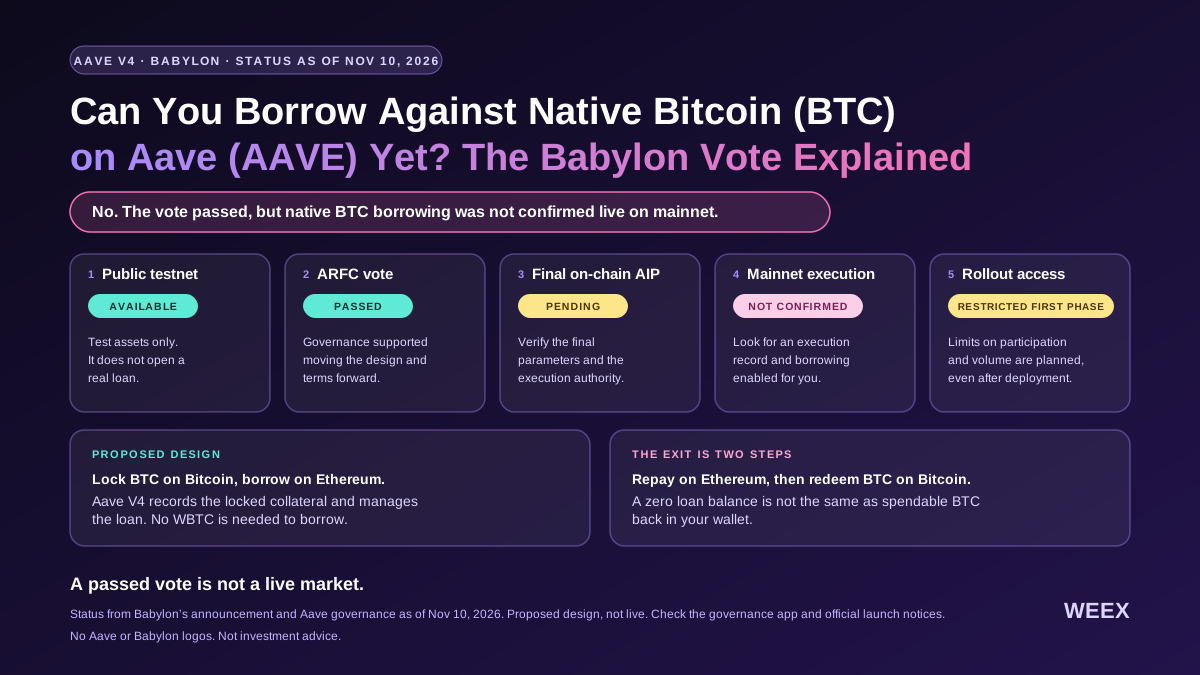
The answer is No. As of November 10, 2026, the Babylon integration had passed Aave’s ARFC governance vote, but native Bitcoin borrowing was not confirmed live on mainnet. A public testnet was available. The next step was a final on-chain Aave Improvement Proposal (AIP), followed by execution and a staged rollout. If the integration launches as proposed, borrowers will lock BTC on Bitcoin and take out a loan on Ethereum without first converting their collateral to Wrapped Bitcoin (WBTC).
The most useful detail in the proposal is easy to miss: borrowers may never need to hold WBTC, yet WBTC can still be involved if their position is liquidated. The integration changes how borrowers post and recover collateral. Understanding the exit matters at least as much as understanding the deposit.
Key Takeaways
- The vote advanced the proposal. It did not activate native BTC borrowing. Babylon was targeting late 2026 for a restricted first rollout, subject to final approval and launch readiness.
- The collateral stays on Bitcoin. Aave V4 would use a record of the locked BTC to manage the loan on Ethereum. That record is not a wrapped token the borrower can trade.
- Repayment and BTC redemption are separate steps. Paying off the loan on Ethereum does not immediately return the BTC to a spendable Bitcoin wallet.
- A single vault can be seized in full. Splitting collateral across ordered vaults can change how much BTC is seized in a liquidation, though it does not prevent liquidation.
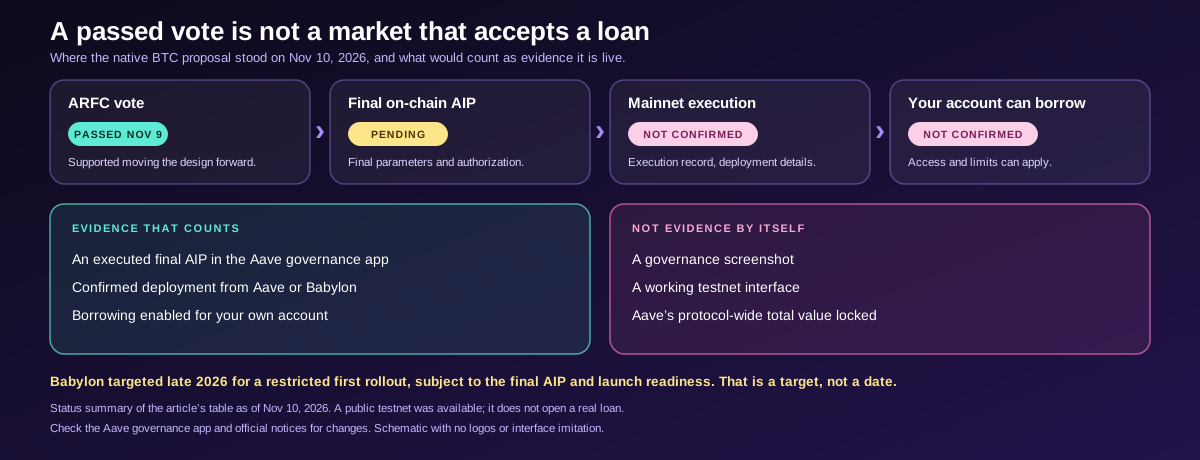
- Aave’s total value locked is not evidence that the new market is live. The relevant evidence is an executed AIP, confirmed deployment, and borrowing enabled for your account.
What Did the Aave (AAVE) Babylon Vote Actually Approve?
The November 9 result advanced the Aave Request for Comment (ARFC) for onboarding native BTC as collateral on Aave V4. The vote supported a dedicated lending market and a separate mechanism for handling liquidations. In its announcement of the vote result, Babylon identified the final AIP as the next step and said the initial rollout would limit participation and volume.
| Stage | Status as of November 10, 2026 | What it means for borrowers |
|---|---|---|
| Public testnet | Available | Users can explore the workflow with test assets. This does not open a real loan. |
| ARFC vote | Passed | Governance supported moving the proposed design and commercial terms forward. |
| Final on-chain AIP | Still pending in the latest announcement | This is the step to verify for final parameters and authorization to execute the change. |
| Mainnet execution and activation | Not confirmed | Look for an execution record, official deployment details, and confirmation that borrowing is enabled. |
| Access during rollout | Restricted first phase planned | Even after deployment, check whether your account can use the market and whether limits apply. |
The practical distinction is between a proposal that passed and a market that accepts a loan transaction. You can track the former in the Aave governance proposal thread. For the latter, check whether the final proposal has been executed in the Aave governance app and whether Aave or Babylon has confirmed that the deployed market accepts borrowers. A governance screenshot or a working testnet interface cannot establish either point.
How Would a Native Bitcoin (BTC) Loan on Aave (AAVE) Work?
The proposed market separates where the collateral sits from where the debt is recorded. The borrower locks BTC in a Taproot output on the Bitcoin network. Aave V4 on Ethereum reads a record of that collateral and manages the loan balance, interest, and health factor. The record is an internal accounting entry: as Babylon’s technical integration documentation explains, the borrower cannot transfer, sell, or bridge it.
Consider a borrower who locks BTC and borrows USDC. The BTC remains in its Bitcoin vault, while the USDC loan and accrued interest are accounted for on Ethereum. If the borrower wants to close the position normally, they repay the outstanding USDC debt, including interest, then withdraw the vault from the lending position and complete redemption on Bitcoin.
That last step is easy to overlook. Babylon’s withdrawal and redemption documentation describes two paths: a normal exit handled through the vault provider and a self-claim route that requires the relevant keys and artifacts prepared at vault creation. Anyone evaluating the product should check what they need to retain for recovery and how long the BTC redemption process can take. A zero loan balance on Ethereum and spendable BTC back in your wallet are two different milestones.
Native Bitcoin (BTC) vs. Wrapped Bitcoin (WBTC) as Aave (AAVE) Collateral
Both approaches can support crypto loans backed by exposure to Bitcoin’s price. The difference is what the borrower deposits and what happens to that asset if they repay or get liquidated.
| Question | Proposed Babylon native BTC route | Standard WBTC collateral route on Aave |
|---|---|---|
| What do you deposit? | BTC locked in a vault on the Bitcoin network. | WBTC supplied to an Aave market that accepts it as collateral. |
| Where is the loan managed? | Aave V4 on Ethereum, using a record of the Bitcoin vault. | On the chain where the selected Aave market operates. |
| How do you repay? | Repay the borrowed asset plus accrued interest on Ethereum. | Repay the borrowed asset plus accrued interest on the market’s chain. |
| What comes back after a normal exit? | Native BTC after withdrawing and redeeming the vault on Bitcoin. | WBTC after withdrawing from Aave. Converting it to native BTC is a separate step. |
| How is liquidation handled? | Individual vaults can be seized only in full. A liquidity provider can settle with the liquidator in WBTC while BTC redemption happens separately. | The liquidator repays eligible debt and receives the applicable collateral under the market’s rules. There is no Bitcoin vault to redeem. |
If you already hold WBTC and intend to keep using it on Ethereum, the conventional route avoids a Bitcoin-side redemption step when you close the loan. If your starting asset is native BTC and your goal is to get native BTC back after repayment, Babylon’s design removes the need to wrap the collateral yourself. In exchange, you need to understand vault recovery, the timing of redemption, and the effect of vault size on liquidation.
-- Price
What Happens If Your Native Bitcoin (BTC) Collateral Is Liquidated?
Aave’s health factor compares the value of your collateral, adjusted by the applicable liquidation threshold, with the value of your debt. A falling BTC price lowers the value of the collateral. Accruing interest increases the debt. A position becomes eligible for liquidation when the health factor falls below 1, as explained in Aave’s health factor guide.
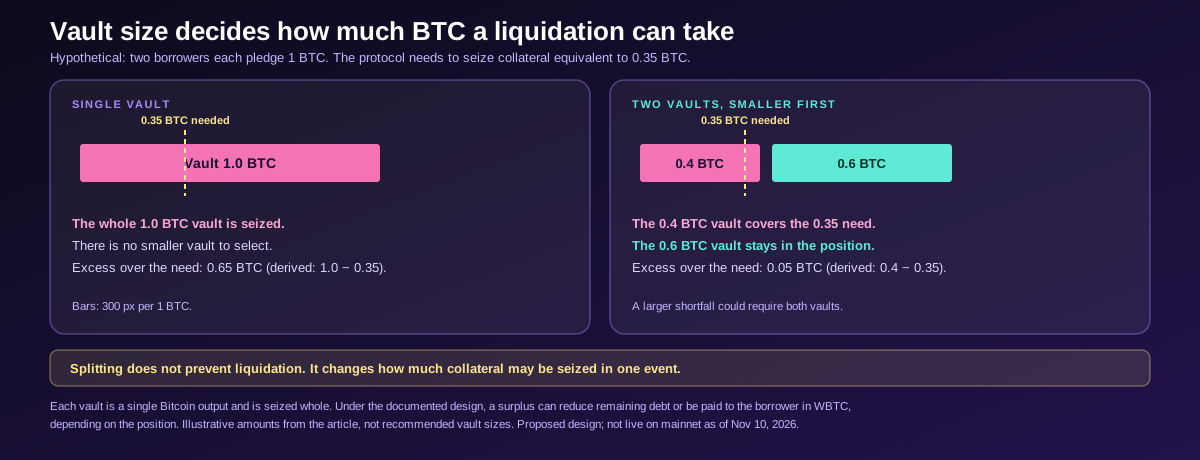
Babylon adds a second question: How much BTC sits in each vault? Its liquidation documentation explains that a vault is a single Bitcoin transaction output. Bitcoin spends that output as a whole. The integration therefore selects whole vaults in order until it covers the required seizure amount. A position with multiple vaults can be partially liquidated even though each individual vault is indivisible.
For illustration, imagine two borrowers each pledge 1 BTC. One puts it in a single vault. The other uses two vaults, 0.4 BTC and 0.6 BTC, with the smaller vault first. If the protocol needs to seize collateral equivalent to 0.35 BTC under the applicable rules, the single-vault setup has no smaller vault to select. In the split setup, the first 0.4 BTC vault could cover the seizure, leaving the second vault in the position. These are illustrative amounts, not recommended vault sizes. A larger shortfall could require both vaults.
There is also a difference between what gets seized and how the surplus is handled. In the documented design, if a whole-vault seizure exceeds the amount required, the excess can reduce remaining debt or be paid to the borrower in WBTC, depending on the position. That is why a borrower who posted only native BTC might still receive WBTC in a liquidation.
What Do the Proposed Credit Lines and Buybacks Mean?
Three figures describe different things: the initial capacity proposed for the market, the value already locked across Aave, and the revenue the new market might eventually earn. Treating them as interchangeable makes the integration look further along than it is.
The announced configuration includes about $21 million in starting stablecoin credit lines. That is planned lending capacity, not $21 million already borrowed or $21 million in BTC deposited. The Aave dashboard on DefiLlama, meanwhile, tracks the broader protocol. Its aggregate TVL does not tell you how much BTC is pledged through Babylon. After launch, the useful market-specific figures would be native BTC locked, outstanding debt, and available borrowing liquidity. Each answers a different question: how much collateral borrowers supplied, how much they used, and how much room remains.
The approved commercial framework also links potential token buybacks to revenue from this integration. Under the announced terms, Aave retains the first $500,000 per 12-month period after launch. In the next tier, from $500,000 to $2 million, 4% of the revenue in that band goes to the buyback fund. For example, if the integration earned $1 million in the period, the published terms would imply a $20,000 buyback allocation: 4% of the $500,000 above the first threshold. That calculation illustrates the terms; it is not a forecast of revenue or purchases.
Trade Aave (AAVE) and Bitcoin (BTC) on WEEX
The AAVE/USDT perpetual market and BTC/USDT perpetual market offer price exposure where trading is available. Open the relevant contract, check its live status, and review the funding rate, margin, and estimated liquidation price before entering a position. To buy the asset itself, use AAVE/USDT spot or BTC/USDT spot. Trading either pair is separate from opening a Babylon-backed loan.
The WEEX Shopping Fest is scheduled through November 25, 2026, at 23:59 (UTC+8). Eligible users can select Register Now, review their daily or cumulative futures tasks, and use any Lucky Egg chances they earn before the event closes. The rules count eligible futures volume and exclude zero-fee futures trades. Check your applicable rates and the event terms before trading.
WEEX Editorial View
The vote matters because it brings native BTC closer to being usable in an Aave lending market without requiring borrowers to wrap it. But the best test of the product will be whether an eligible borrower can complete the entire round trip: lock BTC, borrow, repay, and recover spendable BTC on Bitcoin.
We would put more weight on a confirmed mainnet deployment and documented redemption times than on protocol-wide TVL or buyback headlines. For borrowers, the most useful launch details will be who can participate, which assets can be borrowed, what the final risk parameters are, and what happens to the BTC if a position becomes unhealthy. Those details determine whether the product solves the problem a BTC holder actually has.
FAQ
1. Can I Borrow USDC Against Native BTC on Aave Right Now?
As of November 10, 2026, the proposed Babylon route was available for testing, but mainnet borrowing had not been confirmed. Check for an executed final AIP and a launch notice that specifies who can borrow.
2. Do I Need WBTC to Open a Babylon-Backed Loan?
Under the proposed design, no. The borrower would post native BTC on Bitcoin. WBTC can still be used by the liquidation mechanism or paid to the borrower as a surplus after liquidation.
3. Can I Withdraw My Bitcoin Immediately After Repaying?
Repayment clears debt on Ethereum. A full exit also requires withdrawing the vault from the lending position and redeeming the BTC on Bitcoin. Check the redemption timing before relying on that BTC for another transaction.
4. Does Splitting BTC Across Two Vaults Stop Liquidation?
No. Splitting can give the protocol a smaller vault to seize first. If that vault is insufficient, it can still seize additional vaults. The split changes how much collateral may be seized in one event; it does not change whether the loan is eligible for liquidation.
5. When Will the Babylon Integration Launch on Aave V4?
Babylon targeted late 2026, subject to the final AIP and launch readiness. It also said the first rollout would limit participation and volume. The target is not a confirmed date for public access.
This content is provided for general informational purposes only and doesn't constitute financial, investment, legal, or tax advice. Any events, rewards, online promotions, or related information mentioned herein should not be considered a recommendation, solicitation, or invitation to purchase, sell, trade, or otherwise deal in any crypto assets. Crypto assets are highly volatile and may result in loss. The availability of WEEX services, products, and related events may vary by region. You are responsible for ensuring that your participation is in accordance with applicable local laws and regulations.
You may also like

Aave DAO Supports Native BTC as Collateral for Aave V4 through Proposal

Keplr halts Google, Apple logins as $6M wallet drain hits Cosmos

Web3Auth Announces Rescue Address, Partial Transfers for Asset Recovery

Follow the Money: $2.4 Billion in Investments, Major Round for Kalshi, and High Attention to AI — October 2026

Bitcoin Dual Staking Protocol b14g Approximately 97 Million CORE Unauthorized Withdrawal

Crypto VC funding: Kalshi raises $1b, HIVE secures $129m loan

Spicenet Completes $5 Million Series A Financing Led by dao5

3 payment rules control Aave’s native Bitcoin market, but only WBTC settles them

Aave Advances Native Bitcoin Collateral Proposal

Native Bitcoin collateral on Aave triggers WBTC pool deficit
Babylon Labs Proposes Adding Native Bitcoin as Collateral in Aave V4

Best Bitcoin staking platforms in 2026: BTC yield compared

Rialo eyes South Korea as institutions look to move financial services onchain
Solv Raises $25 Million, Stuck with 50 Bitcoins

The End of an Ideal: Why the Crypto Industry is Heading Towards Homogenization?

How Stacks plans to build the home of Bitcoin-native finance

BTC Only 1.5% Monetized, Expanding Native Financial Experiments

The generation that grew up with cryptocurrencies is investing like their grandparents

HashKey Cloud and Cactus Custody Form Strategic Partnership to Create Institutional-Grade Staking Services
What is restaking and how EigenLayer turns staked ETH into shared security

HSBC: 45% of wealthy investors to increase crypto exposure in 12 months
2-Year-Old Girl Dies in Villa Gesell, Investigation Underway: Her Mother Had Been Acquitted in the Deaths of Two Other Daughters

UPBIT will list Babylon (BABY) and support the KRW market
Babylon Foundation: Will deposit 3 million USDT into Aave to show support for DeFi
Aave DAO Supports Native BTC as Collateral for Aave V4 through Proposal
Keplr halts Google, Apple logins as $6M wallet drain hits Cosmos
Web3Auth Announces Rescue Address, Partial Transfers for Asset Recovery
Follow the Money: $2.4 Billion in Investments, Major Round for Kalshi, and High Attention to AI — October 2026
Bitcoin Dual Staking Protocol b14g Approximately 97 Million CORE Unauthorized Withdrawal
Crypto VC funding: Kalshi raises $1b, HIVE secures $129m loan
Latest articles


Latest coin listings on WEEX


