
Bloomberg: With Democrats Regaining Control of Congress, Are Good Days Over for the Crypto Industry in Washington?

 Prefer us on Google
Authors: Teresa Xie, Scott Patterson, Bloomberg
Compiled by: Jiahua, ChainCatcher
Political Advantage is Fading
The crypto industry’s political fortune in Washington has come to an abrupt halt. With the Democrats sweeping both houses of Congress in the midterm elections, the industry faces stricter regulations and a closer scrutiny of its ties to President Trump.
For the past two years, the crypto industry has enjoyed a level of treatment in the U.S. capital that few businesses receive: a president who prioritized digital assets as a national agenda while accumulating personal crypto wealth; regulators who cleared obstacles for broader adoption of crypto assets; and a Congress controlled by Republicans that was supportive of the industry's demands.
Now, as this unusual political advantage fades, the crypto industry faces a tougher test: how to establish a lasting influence in the financial sector. The Democratic sweep of Congress may make it more difficult for the industry to push for comprehensive legislation that aligns with its interests, while also increasing the likelihood of congressional investigations into Trump’s crypto dealings.
"Many key figures in the crypto industry have allied with the Trump family," said Austin Campbell, a crypto expert, former banker, and current adjunct professor at NYU Stern School of Business. "They will likely have to face the consequences."
In August, President Trump met with crypto executives at the White House in Washington.
Crypto Legislation Will Face Greater Resistance
It is well known that Trump launched his own digital asset, invited crypto executives to the White House, and incorporated the industry's demands into his policy agenda. Meanwhile, significant victories achieved by the crypto industry are closely tied to his presidency, but Trump’s personal financial interests have complicated the industry’s efforts to garner broader political support.
These contradictions became apparent in September when the Senate failed to advance the CLARITY Act, which was intended to establish clearer rules for exchanges and other digital asset businesses. Trump’s crypto dealings became a focal point of controversy, but disagreements over stablecoin rewards, investor protection, and competition in the banking sector also contributed to the stalemate.
Now, the elections will change the landscape of this legislative debate. The Democrats have signaled plans to strengthen restrictions on conflicts of interest and consumer protections, as well as expand the SEC’s role in regulating digital assets. These changes will diverge from the regulatory framework many crypto companies sought during the Republican-controlled Congress, but if the industry can gain bipartisan support, it may open a new path for legislation.
Adam Minehardt, Chief Policy Officer at Hyperliquid Policy Center, stated, "As the industry readjusts to the new congressional leadership, it will take a defensive posture at least initially."
The significant political contributions made by the crypto industry may also yield consequences. In 2024, crypto lobbying groups spent millions supporting the campaign against then-Senator Sherrod Brown, who ultimately lost. Now, Brown has defeated Ohio Republican Senator Jon Husted to regain his Senate seat. Research firm Capstone noted that Brown may hold an important position on the Senate Agriculture Committee, which oversees the Commodity Futures Trading Commission (CFTC), a key regulatory body for crypto.
Former Senator Sherrod Brown campaigning in Brook Park, Ohio.
Democratic control of Congress also means greater power to investigate Trump’s business interests. Lawmakers have already requested information regarding the president and his family’s business ventures. Trump has consistently denied any conflict between his business interests and presidential duties.
California Congresswoman Maxine Waters has been a vocal critic of Trump’s relationship with the crypto industry, and she is expected to exert greater influence on the House Financial Services Committee; Massachusetts Democrat Elizabeth Warren is anticipated to lead the Senate Banking Committee.
"As the power of committee chairs increases, a series of genuine oversight actions will unfold," Minehardt said. "We have already seen signals from various congressional offices. They will start from various leads to see what they can uncover."
Nevertheless, many of the achievements made by the crypto industry are difficult to overturn. Repealing the federal stablecoin law would require new legislation, while the SEC and CFTC are still formulating relevant rules that could further integrate digital assets into traditional financial markets. Regardless of the election outcome, these efforts can continue under Trump’s administration, although future administrations may reassess the decisions made by regulatory bodies.
Tyler Gellasch, CEO of Healthy Markets Association, stated that Congress indeed has tools to influence regulatory agencies, such as controlling appropriations. Congress can attempt to prevent agencies from using funds for policy matters they oppose. He noted that Republicans have used this tool for years to block the SEC from establishing political spending disclosure rules. He also mentioned that Congress could investigate regulatory decisions and the relationships these agencies have with politically favored companies.
Bitcoin signage on the streets of New York.
Beyond Regulation, the Crypto Industry Faces Security Challenges
The market presents another challenge. Regardless of which party is in power, Bitcoin has historically experienced dramatic cycles of boom and bust, making it difficult to attribute its price outlook solely to political changes in Washington. Despite the regulatory easing and political support during Trump’s presidency that sparked hopes for a golden age of digital assets, Bitcoin remains far below its previous highs.
The recent Binance hack highlighted another challenge: security. The exchange suffered a loss of $6.3 billion but has since compensated for the stolen crypto assets by combining corporate funds with two insurance funds.
Peter Atwater, a part-time economics professor at the College of William & Mary, stated, "The crypto industry needs to make these hacking incidents disappear from the headlines. Repeated occurrences will have an impact. It will be interesting to see if the Democrats will push for a regulatory shift that places greater emphasis on security and robust operations."
Overall, the future of the crypto industry depends far more on its alliances than just with Trump. Today, the field related to digital assets has expanded to include investment funds, stablecoin payments, and financial infrastructure, with institutions involved having long-term interests that will not vanish with the end of a presidential term. For an industry seeking to attract clients across the political spectrum, reducing partisan colors may ultimately be an advantage rather than a setback.
Crypto advocates have already begun to emphasize their bipartisan appeals.
Ji Kim, CEO of the Crypto Council for Innovation, stated, "Digital assets have always had bipartisan support, and we are ready to work with both new and returning members of Congress from both parties."
This content is provided for general informational purposes only and doesn't constitute financial, investment, legal, or tax advice. Any events, rewards, online promotions, or related information mentioned herein should not be considered a recommendation, solicitation, or invitation to purchase, sell, trade, or otherwise deal in any crypto assets. Crypto assets are highly volatile and may result in loss. The availability of WEEX services, products, and related events may vary by region. You are responsible for ensuring that your participation is in accordance with applicable local laws and regulations.
You may also like

SK Hynix (SKHY) Stock Rebounds: AI Memory Demand, Cycle Risk, and Fab Plans

Core inflation excludes oil. Bitcoin investors still cannot ignore it

What Happened Today in the Crypto Market? A Review of the Most Important Cryptocurrency News (November 9, 2023)

Coinbase, Kalshi, and Kraken Support CFTC in Court Dispute Over Perpetual Stock Contracts

US Congress Calls for Limiting NVIDIA Chip Exports to China Amid Spy Scandal

Cryptocurrency Anarchism Lacks Commitment, Coordination, and Reputation, Not New Tokens

Pharos Network Integrates Fireblocks for Institutional-Grade Custody Workflow for RealFi Assets

230,000-Follower 'Crypto Guru' Exposed: 30 Alt Accounts Uncovered for Fan Harvesting

Enza Closes $6 Million Funding Round to Develop Payment Infrastructure

AI Fills Gaps in the Crypto Industry: Fifteen Startup Opportunities to Watch

Trump Media adds 1,510 Bitcoin in Q3 as treasury reaches $1.17B

Bank of Korea: Consider Existing Financial Regulations When Introducing Stablecoins

Dormant Ethereum Wallet Moves $4.6 Million. Scammers Set a Trap in Three Minutes

47% Top Tax Rate Approaches: Seven Tax Reduction Strategies for Australian Crypto Investors

WEEX P2P now supports ILS, BHD, OMR & QAR —Merchant Recruitment Now Open

Hyperliquid Strategies Reports 38.5M HYPE Treasury After $802M Deployment

No Music App on Work Laptops: The Small Rules Behind WEEX Security

SoftBank Reports First Quarterly Net Loss in Two Years, Intel and Data Center Dragging Down Performance
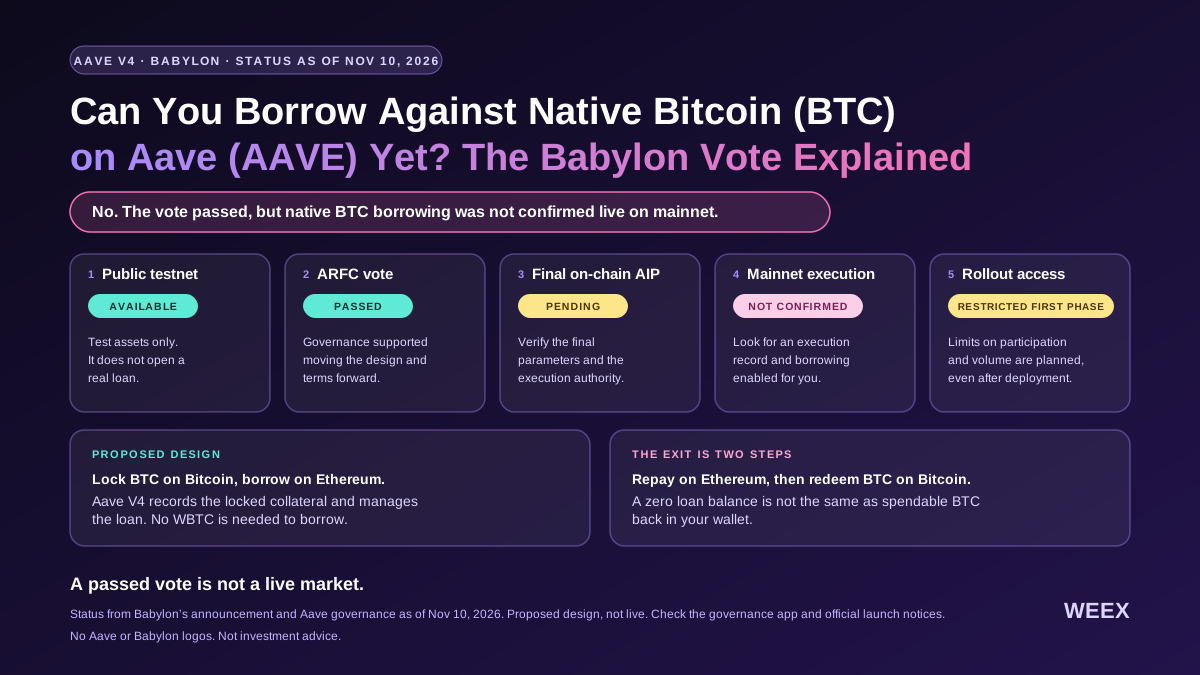
Can You Borrow Against Native Bitcoin (BTC) on Aave (AAVE) Yet? The Babylon Vote Explained
Can you borrow against native Bitcoin on Aave yet? See what the Babylon vote approved, what still needs to launch, and how BTC liquidation would work.
Why Doesn't Bitcoin Always Rise When Stocks Rally?

Financial Commission to Manage Stock Market Volatility with Sidecars and High-Frequency Trading Checks
IMF urges Kenya to make crypto firms share customer data under Travel Rule
Kim & Chang Lawyer: "Excessive Responsibility Should Not Be Imposed on Stablecoin Issuers"
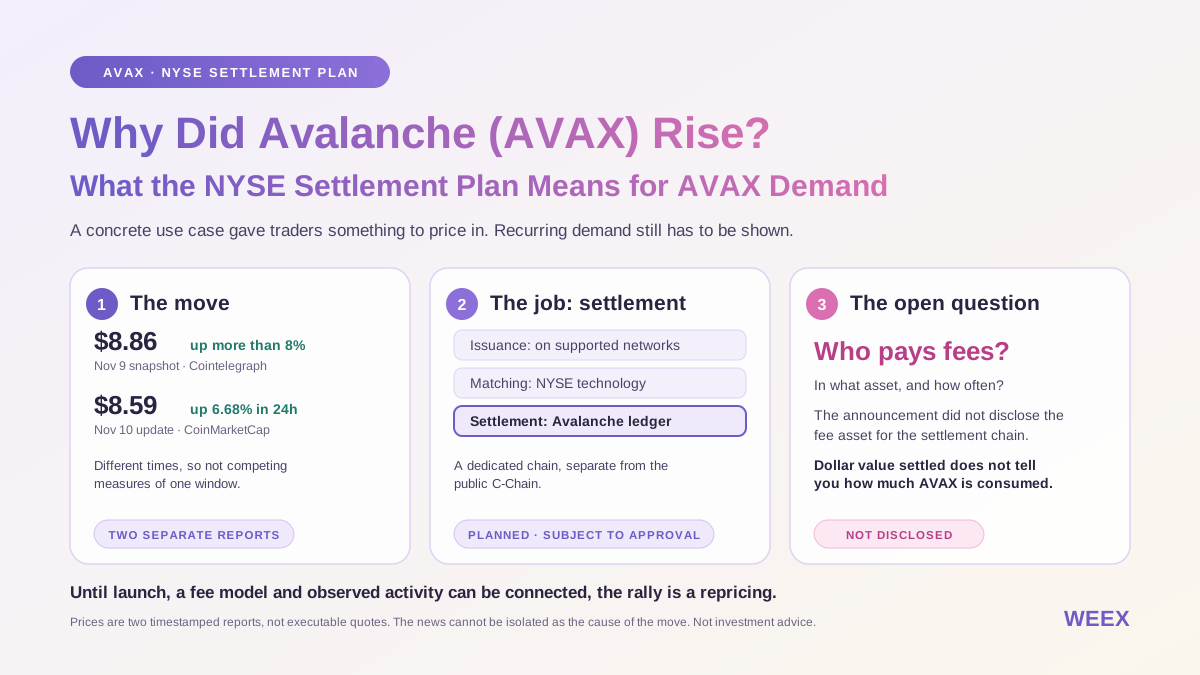
Why Did Avalanche (AVAX) Rise? What the NYSE Settlement Plan Means for AVAX Demand
See why Avalanche (AVAX) rallied after the NYSE settlement announcement, how the dedicated chain would work, and what could create demand for AVAX.

Cryptocurrency Security Checklist: Four Lessons from Phemex Safety Hub Vol. 05–08
Solana's Former DEX Leader Prepares to Go All In on US Stocks

PIEVERSE Price Up Nearly 80% in a Week: Futures Activity, the November 14 Unlock and What Is Confirmed
PIEVERSE rose about 79% in seven days with futures volume far above spot. See what is confirmed about the November 14 unlock and the WEEX Lucky Eggs campaign.

Unauthorized Access to Gnosis Pay's Old Card System Leads to Customer Data Breach

Alchemy Pay Says Mississippi Licence Expands US Money Transmission Coverage to 20 States

Hong Kong Approves Crypto Asset Reporting Rules - Fintech World
SK Hynix (SKHY) Stock Rebounds: AI Memory Demand, Cycle Risk, and Fab Plans
Core inflation excludes oil. Bitcoin investors still cannot ignore it
What Happened Today in the Crypto Market? A Review of the Most Important Cryptocurrency News (November 9, 2023)
Coinbase, Kalshi, and Kraken Support CFTC in Court Dispute Over Perpetual Stock Contracts
US Congress Calls for Limiting NVIDIA Chip Exports to China Amid Spy Scandal
Cryptocurrency Anarchism Lacks Commitment, Coordination, and Reputation, Not New Tokens
Latest articles

Latest coin listings on WEEX


